A dashboard is only as good as the infrastructure running it. You can have the most elegant interface and the most relevant data in the world, but if the system slows under load, requires constant maintenance, or charges you for capacity you are not using, the value erodes quickly. This is the part of the conversation that often gets skipped in favour of talking about features — but for CXOs making build decisions, it matters just as much.
When Traffic Spikes, the System Keeps Up
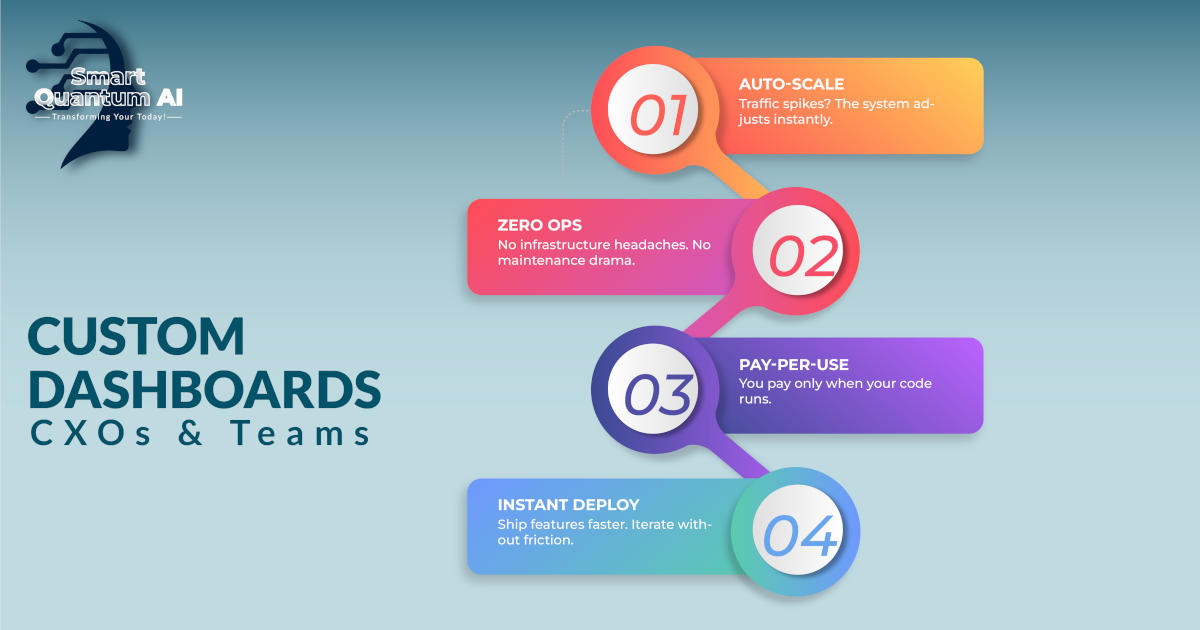
Business is not linear. A product launch, a campaign going live, a quarterly review where the entire leadership team logs in simultaneously — these moments create sudden surges in demand. Systems that are not built to scale handle these moments badly: slow load times, timeouts, or outright failures at exactly the point when the dashboard needs to be most reliable. Auto-scaling infrastructure removes this risk by adjusting capacity in real time to match whatever demand actually looks like at any given moment.
No One on Your Team Should Be Managing Servers
Infrastructure management is a hidden cost that rarely appears in initial project estimates but shows up consistently in operational budgets. Patching, monitoring, capacity planning, handling unexpected outages — these tasks require dedicated attention and technical expertise. Modern deployment approaches move this burden away from your team entirely. The infrastructure runs, updates, and recovers from issues without requiring anyone in your organisation to intervene. Your team focuses on using the dashboard, not maintaining the environment it runs on.
You Pay for What You Actually Use
Traditional server-based infrastructure charges you for capacity whether it is being used or not. A pay-per-use model flips this — costs align with actual usage, which means quiet periods are genuinely cheaper and growth in usage is reflected proportionally in costs rather than in large upfront infrastructure investments. For businesses scaling a dashboard from a small leadership team to a larger operational deployment, this model is considerably more economical than provisioning for peak capacity from day one.
Shipping Updates Without the Friction
A dashboard that cannot be updated quickly becomes stale. Business needs change, new data sources become relevant, and users will always have feedback that leads to improvements. Continuous deployment pipelines mean that changes — whether minor fixes or significant new features — can be shipped rapidly without taking the system offline or requiring a lengthy release process. Iteration happens at the speed the business needs, not at the speed the infrastructure allows.
What We Build at Smart Quantum AI
The dashboards we build for CXOs and operational teams are designed with all of this in mind — not just what appears on screen, but how reliably it runs, how easily it scales, and how much it costs to operate over time. If you are evaluating a custom dashboard for your team, these are the questions worth asking before the first line of code is written.